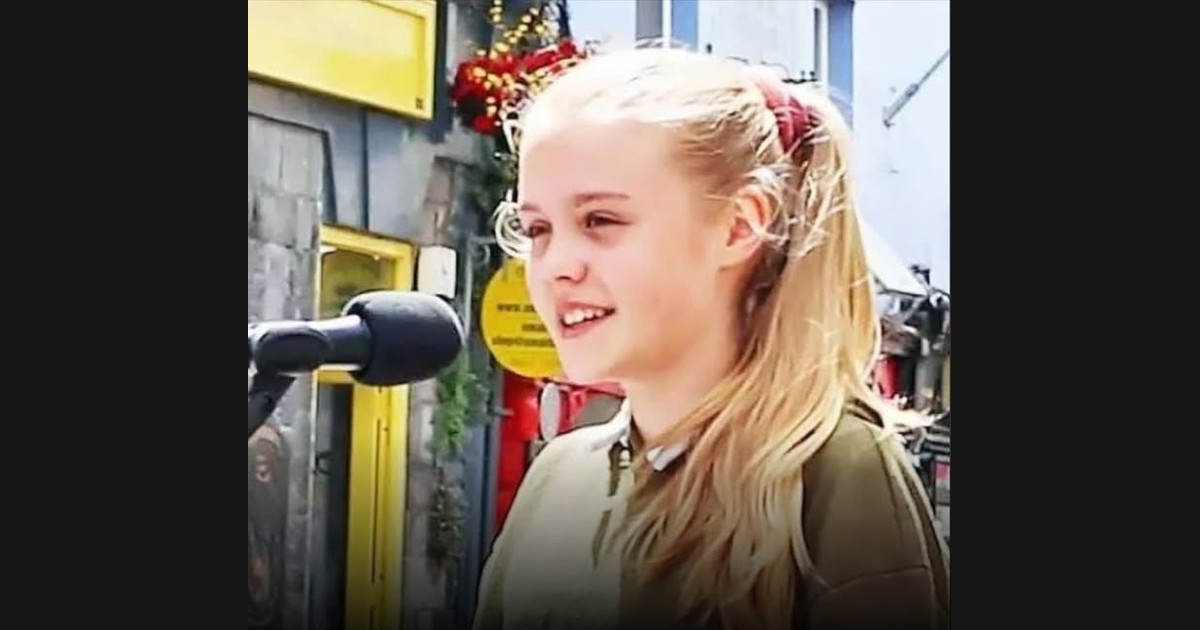
A channel name is not always a filming location. Mia Black’s “You Are the Reason” appears on Dublin City Today, but the uploader’s description explicitly says the footage was filmed in Galway and came from her father. That detail restores a specific place and source to a widely shared street performance.
The recording introduces Black through a familiar Calum Scott song. The later Boyce Avenue collaborations offer another route into her work: instead of leaving her attached to one age-labeled street clip, they present her inside named, professionally credited acoustic releases.
Watch on YouTube ↗
A street presentation has a different audience boundary
Public-space singing takes place beside ordinary activity. People may encounter the music while passing through, rather than arriving for a scheduled concert. The performance needs a recognizable musical thread that can remain understandable within that environment.
A familiar ballad supplies one such thread. Its melody and returning sections can give a listener an entry point even without a spoken introduction. The interpretation still depends on continuity between phrases, not only on the location’s immediate novelty.
The upload’s age label belongs to the recording’s presentation; it should not be mistaken for a current age. A performer can continue making music after the clip through which many people first encountered them.
A collaboration makes the musical roles explicit
Boyce Avenue’s “Beauty and the Beast” release identifies its partnership with Black as a piano-acoustic cover. The description credits the audio and video production, recording team and strings, giving viewers a fuller account of the finished work.
Watch on YouTube ↗
The credits name Adam Barber for engineering, mixing and mastering, and identify strings performed by Yoed Nir. Those details are useful because the word “acoustic” does not mean that a recording lacks production or contains only the instruments most obvious in a camera frame.
Listen for how the featured voices share the song’s address. A duet can alternate lines, reinforce a phrase or create harmony. The arrangement needs those relationships to remain clear while allowing the participants to retain distinct musical identities.
A different song changes the address
The “I Hope You Dance” collaboration provides another selection within the same broad acoustic-cover setting. Its title offers a wish for another person’s future, rather than simply identifying a dance performance.
Watch on YouTube ↗
That change gives the singers different dramatic material. A listener can compare how a phrase communicates an offer, a hope or an appeal without treating the song’s words as an autobiographical statement by every person performing it.
Follow the artist, not only the first clip
The three recordings do different work. The Galway footage documents a public performance supplied by a family source. The Boyce Avenue videos place Black in collaborations whose production and participating artists are identified directly.
Keeping those contexts clear gives viewers a more substantial path through the material. The opening song provides an accessible introduction; the later releases reveal another setting in which the singer participates. Her musical identity can extend beyond the circumstances and age label of a single recording, while each performance remains connected with its actual source.


