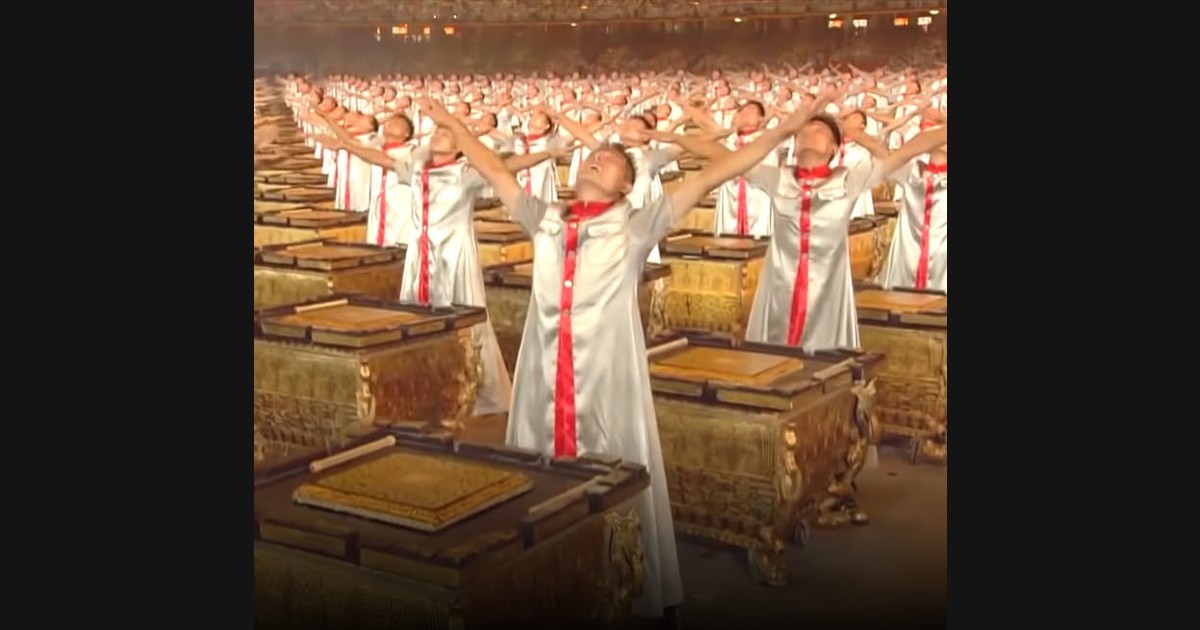
The official Olympic clip identifies 2,008 people drumming together at Beijing’s 2008 opening ceremony. The number is not simply a large estimate: the ceremony’s media guide explains that 2,008 players and instruments symbolized the year of the Games.
The guide identifies the instruments as fou and places the performance in a welcome sequence. Those details give the excerpt a specific ceremonial purpose beyond a general claim that a large group can play loudly at the same time.
Watch on YouTube ↗
Distinguish pulse from pattern
A pulse supplies a continuing reference through time. A rhythm describes how events are organized around that reference. A coordinated percussion presentation can use shared timing while changing the activity carried within it.
For a first listen, follow the continuing sense of movement. On another pass, attend to the distribution of actual strikes and spaces. The two approaches can reveal different features without requiring a written transcription.
For example, several performers can agree on a common reference while leaving different spaces between sounds. A pause does not necessarily mean the underlying timing has disappeared. It can make the next entrance more conspicuous because the shared sequence continues to be understood.
The visible gesture has a musical relationship
Raised arms, prepared movements, and instrument positions make percussion especially readable on screen. A viewer can see activity preparing a sound as well as the moment of contact. Repeating a gesture across a group adds a visual pattern to the audible one.
That does not give a remote viewer a complete technical measurement of synchronization. A camera image and a released soundtrack cannot establish a precise error rate or tell us every detail of how the broadcast sound was assembled.
Describe a visible relationship instead: several areas of the formation preparing an entrance, for example, if that is what the selected shot shows. A defensible observation is more useful than calling thousands of individual actions mathematically perfect.
The welcome frame explains the scale
The official media guide presents the fou performance as a welcome to visitors. Its count connects the participants with the named Olympic year, while the group activity supplies a common public gesture.
The context should remain attached to that particular ceremony. It does not establish a claim about every Chinese performance tradition or the personal views of every participant. A specific program can be described accurately without making it represent an entire population.
Highlights alter the surrounding sequence
Watch on YouTube ↗
The Olympic highlights release offers selected material from the opening ceremony. It can help locate the percussion within a wider visual program, but selection also removes some of the original continuity.
Ask what context the highlight provides before and after the drumming. That is an editorial question about the release, distinct from the musicians’ work inside the ceremony.
The complete ceremony restores the larger frame
Watch on YouTube ↗
The official full recording supplies the wider event. It lets the welcome sequence be considered alongside other ceremonial sections rather than treating the percussion excerpt as a separate concert.
The clearest account keeps three layers visible: shared musical timing, coordinated visible movement, and the welcome’s place in the ceremony. The documented 2,008-player symbolism connects them with the occasion, while the recording gives a particular view of how the public presentation was organized.


