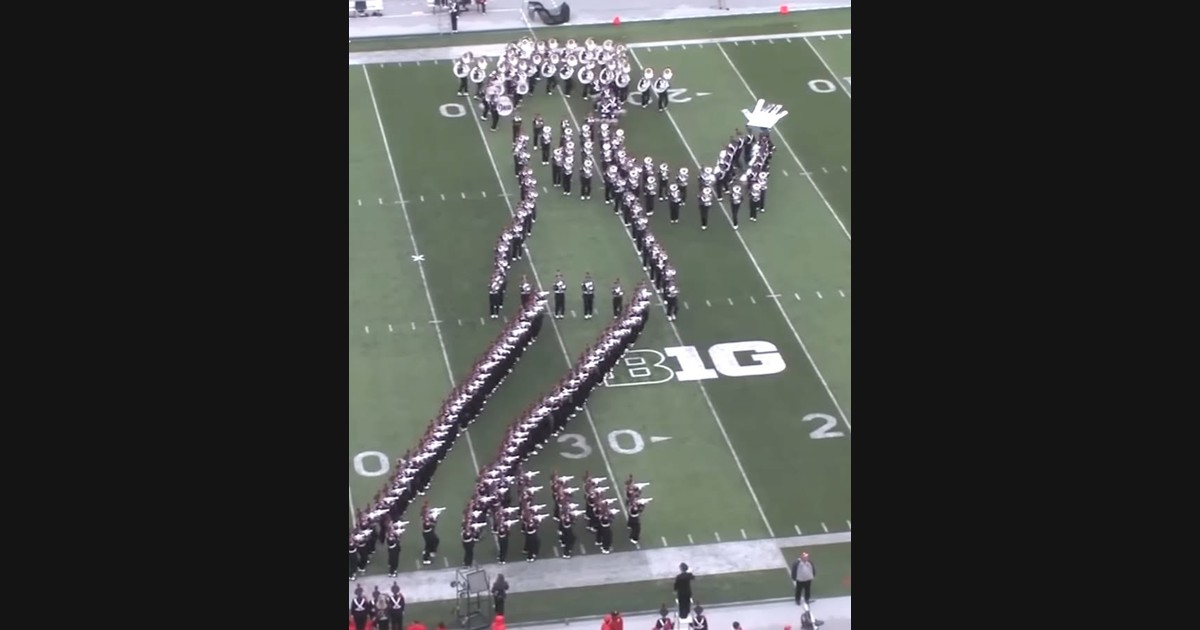
The Ohio State University Marching Band’s Michael Jackson tribute turns the field into a changing image. The familiar moonwalking figure is not one performer enlarged: it is a shape assembled from musicians whose individual positions contribute to the outline.
Ohio State News identifies the show with the October 19, 2013, halftime presentation against Iowa. The university’s drumline archive also preserves that event label. The recording therefore belongs to a particular band performance, rather than an unspecified demonstration repeated whenever the clip circulates.
Watch on YouTube ↗
The outline and the people move at different scales
From an elevated viewpoint, many individual locations combine into one recognizable figure. A small change at the level of a musician can alter a much larger edge or angle in the combined picture.
That is why describing every member as “doing the moonwalk” misses the central device. The large figure presents a movement through changes in its parts. Individual participants have to occupy the positions needed to make that image legible.
A useful analogy is a sequence of drawings: slightly different outlines can suggest one continuing action. On the field, however, the points are living performers who must move between positions while remaining part of the musical presentation.
The transition is part of the achievement
A still photograph can preserve a recognizable shape, but the filmed routine also has to show how that shape develops. Follow an edge or a part of the figure through a transition instead of looking only for the instant when the picture is easiest to recognize.
For example, an outline can become unclear while its components move, then settle into a legible relationship again. A written account can distinguish the target image from the route taken to produce it. That makes the coordination more understandable than simply calling the formation perfect.
The music supplies another sequence at the same time. The band is not only making a field drawing. Its changing picture belongs within a tribute built from Jackson’s repertoire, so the visual and musical tasks have to coexist.
A second view preserves another perspective
Watch on YouTube ↗
Lantern TV’s upload identifies the same Iowa halftime occasion. Compare its view with the Ohio State News presentation before treating it as a different show. A changed camera position can make the spacing easier or harder to read.
This is a useful viewing test: describe the formation without relying on a close-up of one participant. Then compare what the wider image reveals about how several people contribute to one moving edge.
A large ceremony changes the purpose
Watch on YouTube ↗
The official full Beijing 2008 opening ceremony provides another example of coordinated group presentation. It is not an Ohio State source or another Jackson tribute. Its role here is to widen the comparison from a halftime formation to a ceremony with different scale and purpose.
Keep the comparison structural rather than competitive. Ask how individual placements form a readable group image, not which event proves the greater worth of its participants.
Returning to Ohio State, the distinctive device is clear: musicians remain individual moving people while their relationships make a much larger figure appear to move. That combination gives the tribute its visual idea and makes the full transition worth following beyond a single recognizable frame.


