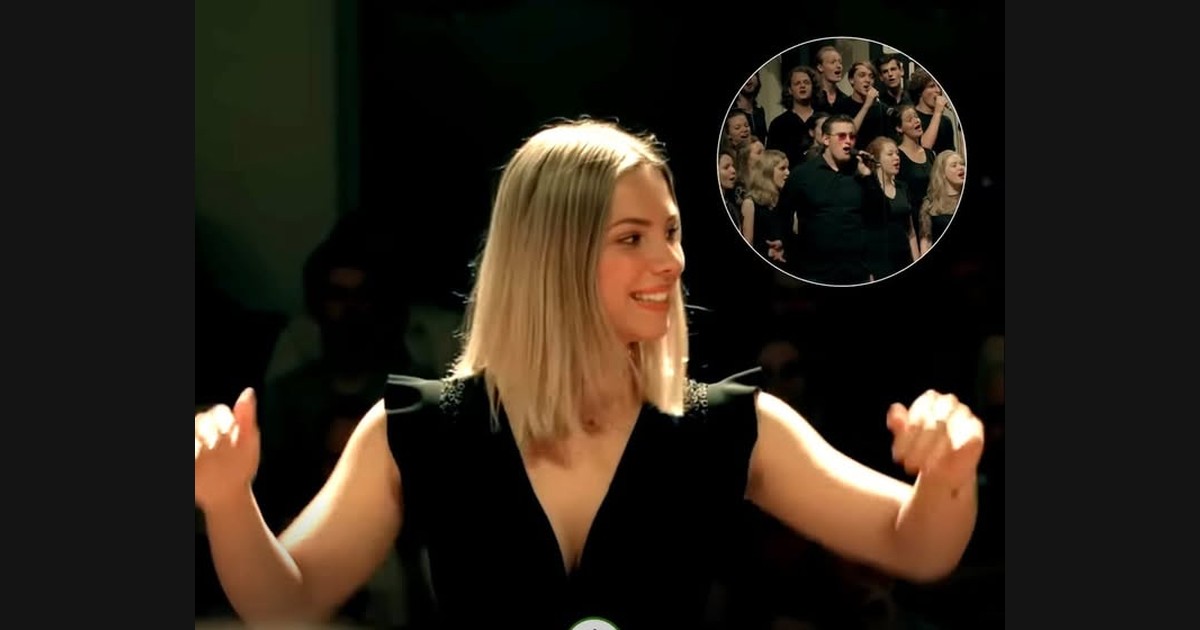
When watching a conductor, it is natural to focus on the movement occurring with a prominent sound. A useful alternative is to look just before an entrance. Conducting often communicates preparation, giving musicians information before they need to act together.
Emma Wieriks identifies arranging and conducting “Copacabana” as part of her Music Education graduation project at the Utrechts Conservatory. Her student-ensemble recording offers a concrete setting for watching that relationship between visible preparation and audible result.
Watch on YouTube ↗
A cue is more than a point at the right person
The New South Wales Department of Education’s Arts Unit describes cues for solo or sectional entrances, returns after rests, and important musical events. Its teaching material explains that a preparatory gesture can communicate the character of the coming entrance as well as its timing.
That provides a better viewing question than asking whether every arm movement corresponds to a louder sound. A cue may help identify when a part enters and how it should enter. Some information belongs to the preparation rather than the instant the sound begins.
For example, imagine an instrumental group waiting through several phrases before returning. A clear preparation can reconnect those players with the continuing performance. The task is a shared arrival, not merely a visually conspicuous gesture for the audience.
Follow three connected moments
- Preparation: look for attention or movement before an audible event.
- Entrance: listen for the part that begins and how it joins the texture.
- Continuation or release: follow how the musical activity proceeds or comes to an end.
The list is a general viewing method, not a transcription of Wieriks’s gestures. Choose an actual passage where the picture gives enough information to make the relationship clear. If an edit hides the preparation, do not invent what happened outside the shot.
The musicians remain active participants
A conductor’s role does not make the ensemble passive. Players still realize their parts, listen across the group, and carry the musical sequence. The cue connects responsibilities rather than replacing everyone’s individual work.
The New York Pops’ educational description similarly identifies starting, stopping, dynamic direction, and tempo among conducting functions. That broader account helps explain why conducting cannot be reduced to a single repeated beat pattern.
In the Wieriks project, Job Uitgeest is credited as lead vocalist. Keep his contribution visible while watching the conductor. A clear vocal entrance belongs to a relationship among the singer, the musical support, and any visible preparation.
The audio release removes the visible guide
Watch on YouTube ↗
Barry Manilow’s “Copacabana” audio supplies another presentation of the song. Without a visible conductor, the listener still hears entrances and transitions. This makes a useful comparison between musical organization and the visual evidence available for it.
Watch on YouTube ↗
The official remix video adds another production frame. It should not be treated as a demonstration of Wieriks’s conducting or as evidence that the student ensemble follows its exact arrangement.
Return to the student performance and describe one preparation-to-entrance relationship you can actually see and hear. That small observation explains conducting more precisely than attributing every successful sound to a dramatic gesture or guessing what happened during unseen rehearsals.


