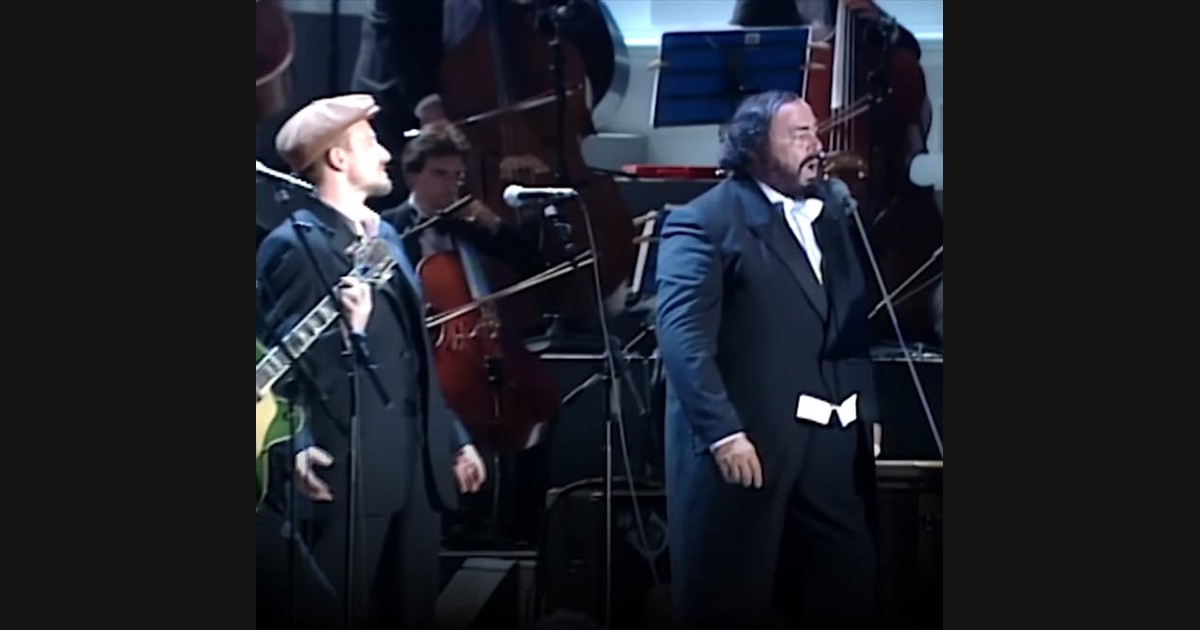
“Miss Sarajevo” is often introduced through the contrast between Bono and Luciano Pavarotti. The voices are an important part of the work, but the project behind them gives that meeting more context. The song came from Passengers, a separate collaboration involving U 2’s members and Brian Eno.
Pavarotti’s official video credits him alongside Eno, Bono and the Edge. U 2’s own album history explains why the musicians used another group name: they did not want the experimental Original Soundtracks 1 to be mistaken for the next conventional U 2 album.
Watch on YouTube ↗
A producer becomes a fellow writer
According to the band’s official account, the project grew from the idea of working with longtime producer Eno as a musician and songwriter. That changes the relationship inside the room. Instead of simply applying a production role to an established band’s work, the participants created a named collective.
This is a useful distinction when reading a musical credit. Producing, writing and performing are related contributions, but they are not interchangeable labels. A collaborator may undertake more than one of them, and a new project name can acknowledge the changed relationship.
Why Pavarotti belongs inside the composition
U 2 identifies “Miss Sarajevo” as the album’s single and confirms Pavarotti’s vocal contribution. The site also places its premiere at the annual Pavarotti and Friends concert in Modena in September 1995. The collaboration was therefore connected with both a recording project and a public performance occasion.
Hearing it as a deliberately built work is more revealing than treating an operatic voice as a surprise decoration. A different vocal tradition can change the scale of a musical statement and create another kind of arrival. The question is what that contrast contributes to the song as it unfolds.
The documentary version changes the visual reference
U 2’s official “Documentary Version” supplies another presentation of “Miss Sarajevo.” It directs attention toward the song’s documentary association rather than making the collaboration’s performers the only center of the image.
Watch on YouTube ↗
The distinction shows how one composition can carry several kinds of context. A performance video emphasizes the musicians presenting it; a documentary presentation can connect the work with a wider subject. These forms need not cancel each other, but a viewer should recognize which frame is being used.
For a focused listen, follow the song’s movement toward a change of vocal character. Consider how the surrounding music prepares the arrival. This gives the contrast a structural role rather than turning it into a competition between styles of singing.
Pavarotti in his own concert repertoire
The official live “Nessun dorma” video gives another reference for Pavarotti’s performance identity outside the Passengers work. It belongs to a different composition and dramatic setting.
Watch on YouTube ↗
Returning afterward to “Miss Sarajevo” makes the project’s choice clearer. The participants did not need to become a single indistinguishable style to collaborate. The Passengers name acknowledges a shared undertaking with room for different identities. Understanding that framework helps the song emerge as more than a famous rock singer and tenor meeting for one memorable passage.


