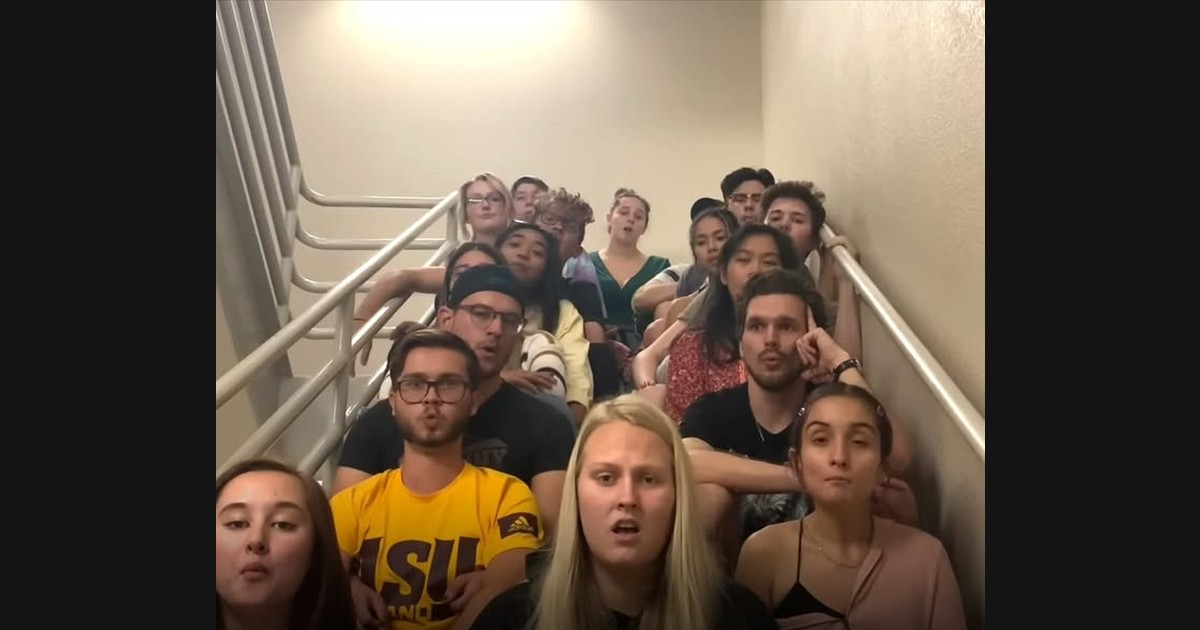
The Devil Clefs’ Billie Eilish mashup places two compositions inside one vocal arrangement. Arizona State University’s own account identifies the group as a student a cappella ensemble and the recording location as a stairwell in the School of Music building. That gives the setting a verified place without requiring a claim about exact acoustics or recording methods.
The title joins “idontwannabeyouanymore” with “when the party’s over.” The related official Eilish videos separate those works again, making the set useful for following what an arrangement preserves and what it has to connect.
Watch on YouTube ↗
Two songs create a joining problem
A multi-song arrangement needs more than recognizable material from each source. It has to make the relationship between them intelligible. A transition can connect the end of one idea with the beginning of another, or a shared texture can allow the listener to move between references without experiencing a complete break.
Choose one place where you recognize a source song. Follow the arrangement before and after that point. Consider what made the recognition possible and what keeps the larger vocal presentation coherent around it.
The combined title does not mean the works have become one original composition. Their separate identities remain useful, especially for a listener who knows only one of the source recordings.
A cappella changes the distribution of work
Without a conventional instrumental lineup as the main visible reference, the listener can follow what the voices supply. A part may carry the principal melody while other contributions establish harmony, continuity, or a recurring pulse.
These functions need not stay permanently attached to one visible person. A passage can change the center of attention while the ensemble maintains the arrangement’s course.
The stairwell setting belongs to the presentation, but its appearance does not establish that the published recording is unedited or entirely unprocessed. The arrangement can be appreciated through its musical relationships without a larger claim about production purity.
Restore one source at a time
Eilish’s official “when the party’s over” video supplies the second selection. It gives that composition its own continuous presentation, rather than making it responsible for a transition into another work.
Watch on YouTube ↗
Listen for a complete idea that you recognized in the mashup. Consider how much of its original surrounding material the vocal arrangement retains, changes, or leaves behind. The comparison concerns arranging decisions rather than fidelity measured only by imitation of a singer’s sound.
The other source has another release context
The final official vertical video presents “idontwannabeyouanymore,” identified in Eilish’s catalog with the 2017 release dont smile at me. It restores the other composition to an artist-centered frame.
Watch on YouTube ↗
Now return to the joining problem. The Devil Clefs arrangement brings material with separate release identities into one performance, so the relationship it creates is another creative layer alongside the source songs.
The three videos form a practical route through that layer: hear the combined arrangement, identify each source separately, then reconsider how the ensemble connects them. The verified campus setting adds context, while the musical comparison supplies a reason to stay beyond the location’s immediate visual appeal.


