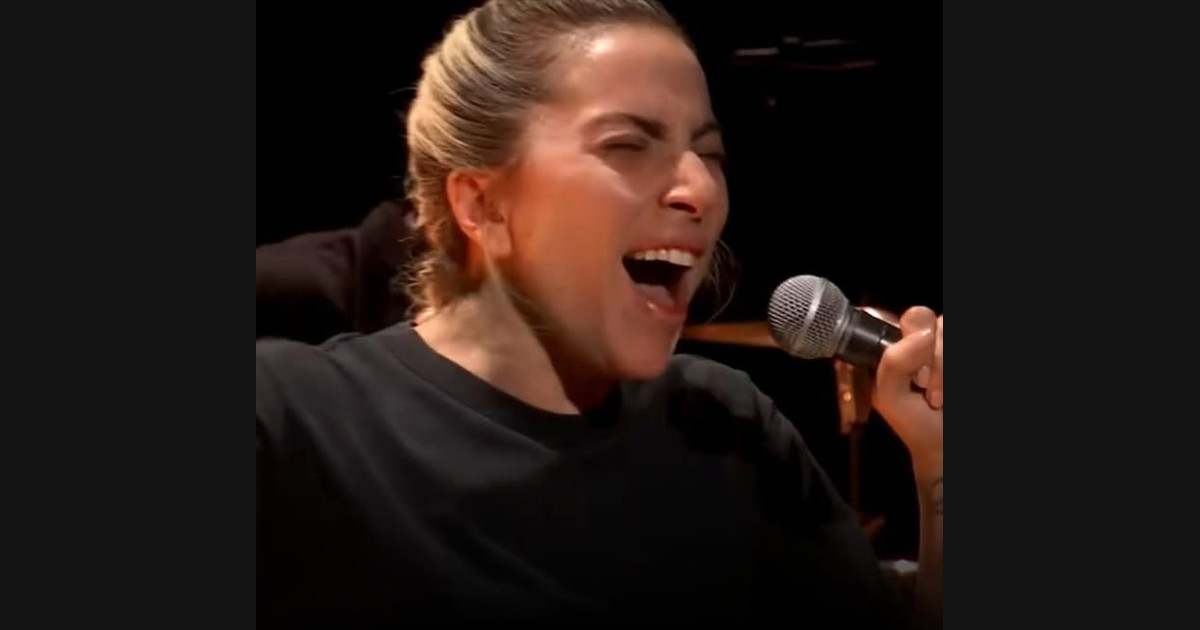
A title can give a ballad its central tension before the listener follows a complete verse. “Hold My Hand” offers a gesture; “Happy Mistake” combines words that pull in different directions; “Million Reasons” uses an exaggerated quantity to suggest weight. Three Lady Gaga performances provide a route through those different kinds of dramatic shorthand.
The opening video is her official 2023 Oscars performance of “Hold My Hand.” The Academy identifies the song with Top Gun: Maverick and credits Gaga and BloodPop for music and lyrics. Here the interest is how a simple verbal idea can organize a song’s address.
Watch on YouTube ↗
An offer creates a relationship
“Hold My Hand” places one person in relation to another through an action. A hand is a concrete image, and the offer implies that the speaker can remain present through something difficult. That basic relationship is understandable without a detailed account of the surrounding situation.
A listener can follow how the musical setting sustains the offer. A returning phrase can reaffirm a statement, while a quieter passage can give the next return another context. The question is not simply whether the voice becomes louder, but how the same central idea remains active across the song.
A contradiction creates room for interpretation
“Happy Mistake,” in Gaga’s official Jimmy Kimmel Live! performance, introduces a different kind of title. A mistake ordinarily suggests something unwanted; happiness changes how that judgment is framed. The combination invites a listener to consider more than one possible relationship between error and value.
Watch on YouTube ↗
The official release connects the song with Harlequin, the companion album to Joker: Folie à Deux. That is release context, not proof that every first-person statement belongs literally to Gaga or to one film character. A singer can interpret a dramatic position without giving a complete autobiographical account.
For a focused listen, identify the point at which the title feels like a destination. Consider what the surrounding music has prepared. A title can function as an answer, a qualification or a fresh question depending on its relationship with what precedes it.
A large number becomes a dramatic scale
“Million Reasons,” presented at the Royal Variety Performance, uses quantity in another way. Its title is not an invitation to count a literal inventory. The exaggeration gives the conflict a sense of accumulated weight.
Watch on YouTube ↗
That distinction matters because a song’s language often compresses experience rather than documenting it item by item. A returning central phrase can hold the listener’s attention while different lines develop the situation around it.
Compare the kind of idea before comparing the delivery
Try describing each title’s job in a few words: offering connection, joining opposing judgments, enlarging the scale of a decision. Then listen to how a complete musical thought leads toward or away from that idea.
The exercise gives these performances a specific relationship without pretending they tell one continuous story. Each ballad supplies a different dramatic tool. Recognizing that tool can make the interpretation clearer, because the listener has something more precise to follow than a general expectation of emotional intensity.


