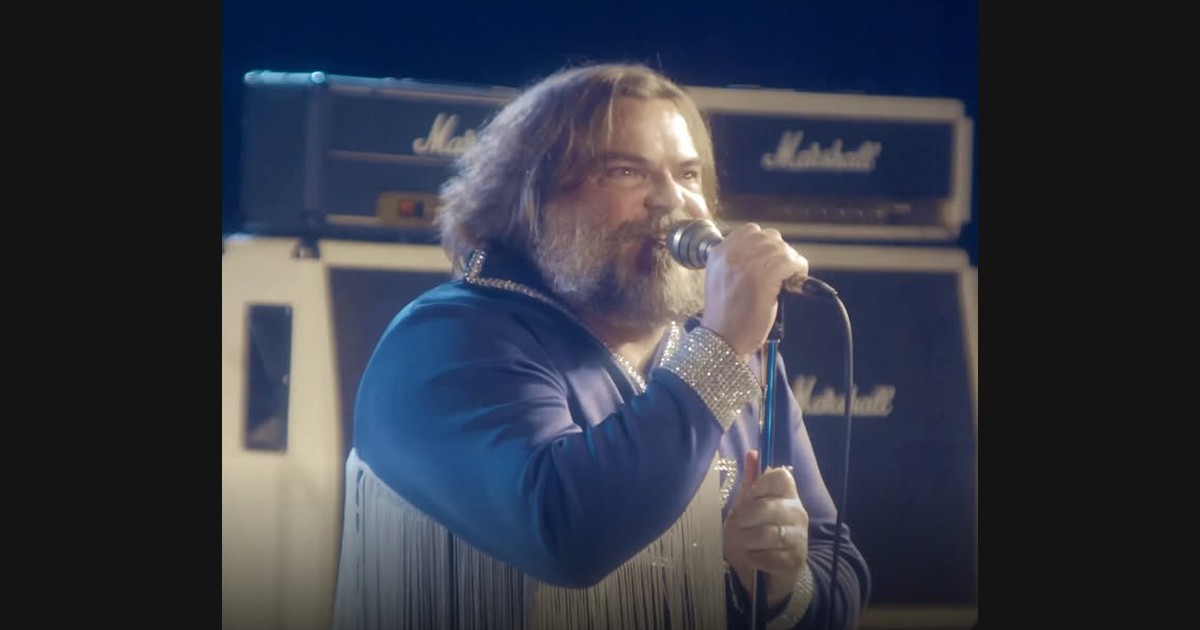
Jack Black’s “Mr. Crowley” tribute is a performance and a made-for-viewing production. Osbourne’s official channel credits a band, but it also names a director, cinematographer, costume designer and audio team. The finished film is the meeting point of those contributions.
The description places the recording within Back to the Beginning and explicitly describes Black as recreating an iconic Osbourne performance. That is a clear production premise: make the reference recognizable while presenting a complete new musical interpretation.
Watch on YouTube ↗
Recognizable character is constructed
Costume and styling can establish a reference before the audience has followed an entire musical phrase. The official credits name Logan Neitzel as costume designer and Lindsay Byrd for hair and makeup. Their work belongs to the process by which a performer enters another artist’s visual world.
This does not require the new performer to become indistinguishable from the original. Black remains a recognizable participant in the tribute. The audience can understand both the reference to Osbourne and the identity of the person making that reference.
Musical direction and film direction are different jobs
The production credits Tom Morello as music director and Lagan Sebert as director. Those labels identify related but distinct areas of coordination. A musical arrangement concerns how the performers realize the work; a filmed presentation also needs decisions about what the viewer sees and how the recorded material is organized.
The video names Johnny Valencia as director of photography and Karl Amdal as editor. A camera view can direct attention toward a singer or an instrumental part; an edit can connect those views. These are general functions of the credited roles, not claims about the exact sequence of production decisions on the day.
The historical reference remains available
Osbourne’s official 1981 live “Mr. Crowley” video gives viewers an earlier performance to consider beside the later tribute. It is a reference for the artist and song, rather than proof that every image in the tribute copies that specific recording.
Watch on YouTube ↗
Compare what establishes identity most quickly. It may be a visual cue, an instrumental idea or the relationship between singer and band. A tribute can draw on several kinds of recognition without reproducing all the conditions of the earlier show.
Sound has a production team too
The official description names Matt Dyson as audio mixer and Carl Restivo as audio engineer, alongside additional technical roles. Those credits make it unnecessary to frame the soundtrack as untouched simply because instruments and performers are visible.
A finished recording can be carefully produced and still preserve real musical work. The relevant distinction is between appreciating the performance and making unsupported claims about how it was captured. Credits provide information about the production without revealing every technical setting.
Another Osbourne performance
The Live & Loud version supplies a further comparison with Osbourne’s own presentation of the song.
Watch on YouTube ↗
Across these recordings, a tribute becomes more understandable when its different jobs remain visible. The band interprets the composition; styling makes a reference legible; camera, sound and editing shape the film. The official credits give names to that work, allowing the result to be appreciated as a collaboration rather than a single celebrity impersonation.


