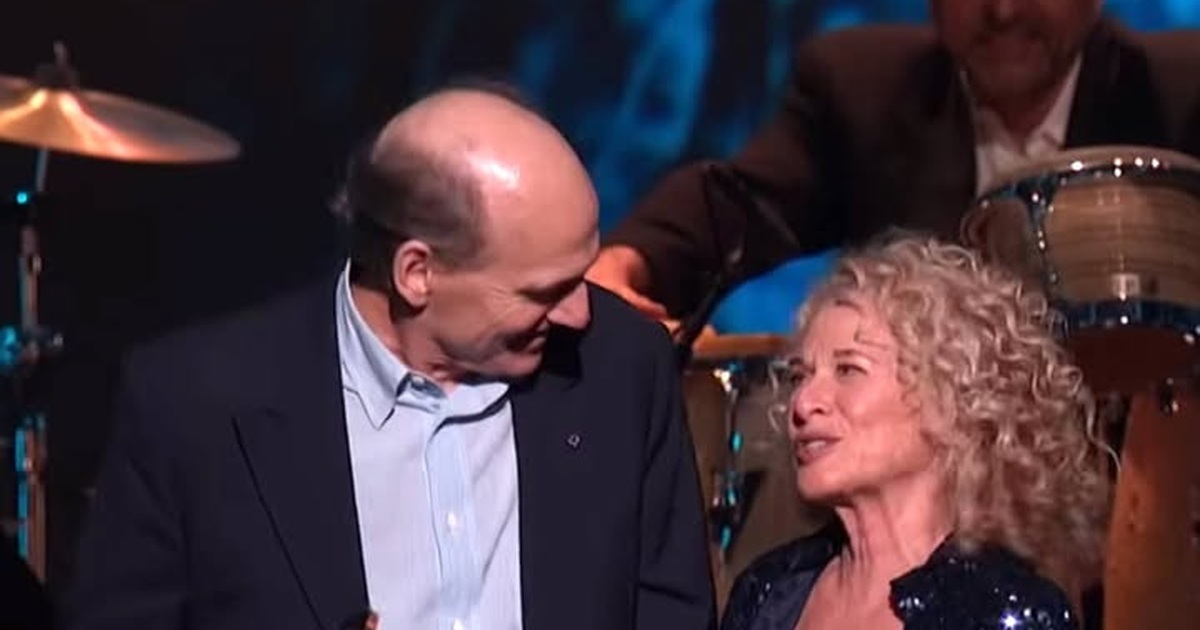
A tribute concert celebrates a career by looking back. Will You Love Me Tomorrow creates a more interesting tension: its speaker is looking forward, uncertain whether the closeness of the present will survive what comes next. When Carole King returned to the song with James Taylor at her MusiCares tribute, that unresolved question sat within an occasion devoted to what her music had already made lasting.
King was honored as the 2014 MusiCares Person of the Year at a Los Angeles gala on January 24. The performance later appeared in A MusiCares Tribute to Carole King, released on DVD and Blu-ray in June 2015. Keeping those dates separate matters when a clip is labeled by the film’s release year: the release preserves an earlier event.
The MusiCares performance
Watch on YouTube ↗
Three points in the life of one song
King wrote Will You Love Me Tomorrow with Gerry Goffin, and the Shirelles brought it to its first hit audience. King subsequently included her own recording on Tapestry in 1971. The MusiCares appearance is another encounter with that writing, rather than the origin of the song or the first time she had made it part of her own repertoire.
Those stages offer different ways into the composition. A listener may arrive through the Shirelles, through King’s album or through a later concert video. Knowing one version does not cancel the others. A song can retain its identity while a new voice, accompaniment or occasion changes the emphasis placed on its question.
The distinction also separates authorship from a simple claim to a definitive interpretation. Hearing a writer sing a familiar song draws attention to its construction, but listeners need not treat every other version as a preliminary draft. Here, the writing has enough openness to support a life beyond any single recording.
A question that does not require a tidy answer
The title places uncertainty within a very short horizon. It asks about tomorrow, not some remote future. That ordinary scale is part of the song’s strength: a large concern about trust can be understood through the immediate distance between one day and the next.
Consider how that question differs from a declaration of either lasting happiness or completed heartbreak. The speaker has not settled the matter. A performance therefore has room to explore hope and apprehension together, rather than assigning the entire song one fixed emotional label.
For a focused listen, attend to the return of the central question. Does it feel like a fresh request, a continuation of the same thought or a moment you interpret differently after the intervening lines? You can make that comparison without turning the lyric into a claim about King’s private life. A singer can inhabit a dramatic situation without supplying a literal autobiography.
Why Taylor’s presence belongs in the story
The Recording Academy’s account of the gala identifies Taylor as accompanying King on the song. His role fits a longer musical association, but it is worth hearing support as a contribution in its own right. A shared performance need not divide every phrase into equal turns or make two singers compete for attention.
Listen for what allows the central musical thought to remain clear when another performer is involved. Sometimes the revealing question is not who has the largest moment, but what the partnership makes possible around the song. That approach keeps the composition at the center of a tribute rich in famous names.
Two related songs, a different concert setting
The next two clips return to King and Taylor’s Live at the Troubadour performances. The concert release arrived in 2010 and documents their November 2007 reunion at the venue. It belongs to a different occasion from the 2014 gala.
Begin with You’ve Got a Friend. Its promise of availability provides a useful contrast with a song asking whether reassurance can be trusted. Compare the situations the two songs establish, rather than expecting the same feeling from both.
Watch on YouTube ↗
Then turn to It’s Too Late, which King wrote with Toni Stern. It offers another perspective: a relationship can be considered after an answer has become difficult to avoid, instead of while its future remains uncertain.
Watch on YouTube ↗
Together, these choices make a compact listening sequence about expectation, support and recognition. The MusiCares performance remains its starting point: a songwriter revisiting a question that her long career has preserved without needing to resolve it for every listener.