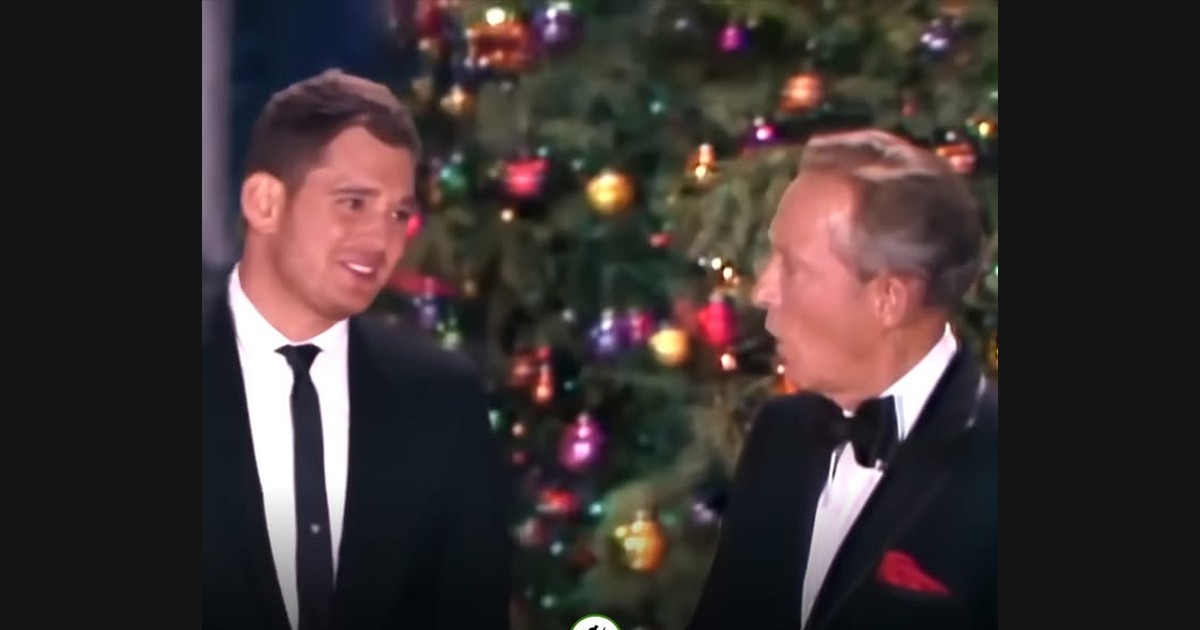
Michael Bublé and Bing Crosby’s “White Christmas” is a duet made across recording dates, rather than an encounter between two singers occupying the same room. Bublé’s official 2012 announcement identifies the selection with his NBC Christmas special. His official German-language account specifies the Crosby material as a 1971 performance from Bing Crosby and the Sounds of Christmas.
That context gives the shared screen image its proper meaning. The construction creates a new musical presentation from an earlier performance; it does not document a physical meeting between the artists.
Watch on YouTube ↗
The archive is an active ingredient
An archival contribution brings its own phrasing, timing, and recorded identity. A new presentation has to make those existing decisions work beside material created later. The earlier performance is therefore more than a decorative image attached to a new singer.
For a close listen, follow a handoff between the featured voices. Consider how the surrounding accompaniment makes the transition intelligible. A continuous musical impression can be constructed across contributions that did not originate in the same session.
The dates also clarify the kind of collaboration being presented. “Duet” can describe the resulting arrangement even though the participants did not negotiate every phrase together in real time. Keeping that distinction visible makes the presentation more informative, rather than less musical.
The construction also changes the meaning of an apparent response. What sounds like one singer answering another can be an arranging decision made around an existing phrase, rather than evidence of an exchange negotiated during a shared session.
A familiar song connects the recordings
“White Christmas” supplies a common work through which the two recorded identities can be brought into relation. The listener may recognize both the composition and Crosby’s association with it before the new arrangement has fully developed.
Separate those forms of recognition. Knowing the tune does not mean every phrase must unfold in the same way. Recognizing a singer’s recorded voice does not establish that the surrounding presentation belongs to the original date.
Crosby’s own reference
The official Crosby video supplies the second selection. It gives the listener another presentation centered on Crosby, allowing the archival duet to be heard alongside an artist-focused reference.
Watch on YouTube ↗
Keep the comparison at the level of musical course and presentation. A later upload can make an older recording available again without changing its original historical position. The publication of an online video is another stage in its circulation.
Bublé with a different partner
The final selection pairs Bublé with Shania Twain on the same song. His official Christmas album catalog lists that duet in its 2011 release, placing it before the 2012 Crosby presentation.
Watch on YouTube ↗
The common composition now allows the partnership to change. Follow how the vocal responsibilities are shared and how the returning material creates continuity. There is no requirement that the two duet presentations pursue the same arrangement.
This gives the set a clear structure: an archival construction, a Crosby reference, and another Bublé collaboration. The song stays familiar while the recorded relationships differ. Understanding how the first duet was made leaves its musical decisions available for attention, without turning the shared image into an invented shared occasion.


