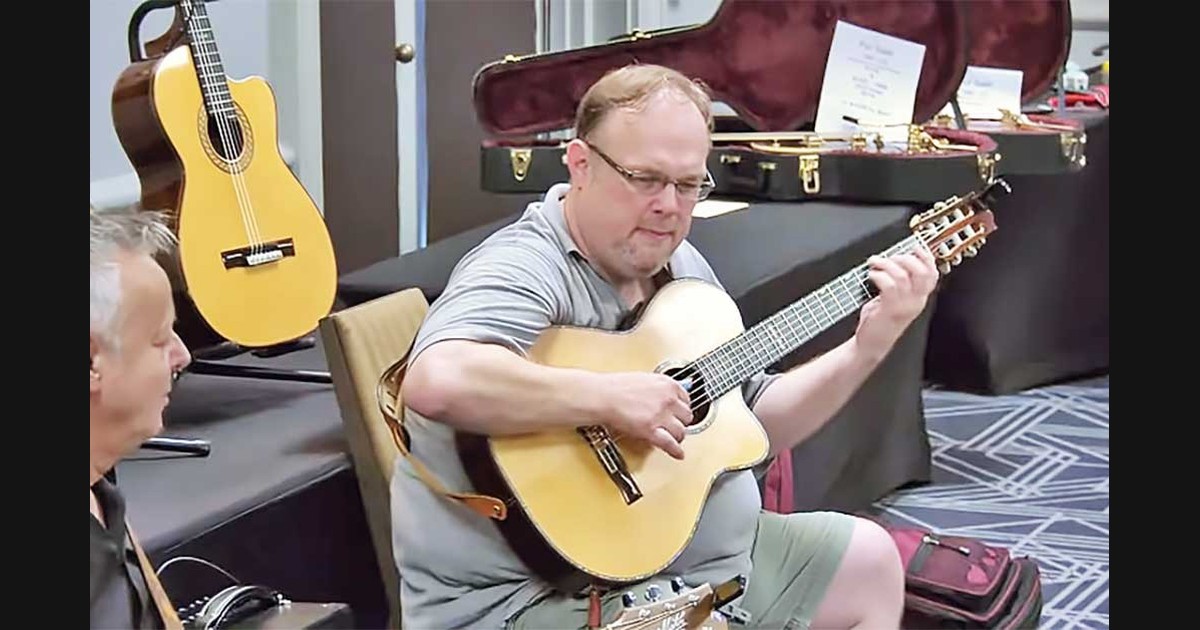
Scott Joplin’s “The Entertainer” has a documented life as piano music before its many later instrumental interpretations. The Library of Congress holds a 1902 score published by John Stark and catalogs it as ragtime. Richard Smith’s guitar performance provides a way to consider how those musical responsibilities can move to another instrument.
The useful starting point is not how quickly the notes pass. It is how one instrument can make a melody audible while also supplying lower support and a continuing sense of movement.
Watch on YouTube ↗
Separate the jobs before following the hands
A piano arrangement can place material in different registers and under different hands. A guitar adaptation must find a workable distribution across strings and fingers. The instrument changes, but the need to distinguish the tune from its support remains.
Smith’s own instructional catalog includes thumb-independence exercises, described as developing a thumb’s bass line and groove alongside the fingers’ work. That supplies a concrete reference for the technique’s musical purpose without pretending to transcribe every movement in this particular clip.
For a first listen, follow only the melody. For a second, follow the lower notes and the continuing accompaniment. Then return to the combined sound. Separating the tasks can reveal why the performance feels like more than a single line of notes.
The rhythm depends on a relationship
The Library of Congress describes ragtime’s characteristic syncopated rhythms: melodic accents can occur away from the expected beat. That idea is easier to hear against a continuing reference than in isolation.
Try a simple nonperforming exercise. Keep a quiet, even count while attending to the melody. Notice when its activity coincides with that count and when it seems to lean across it. There is no need to assign a precise time signature or produce notation to recognize the relationship.
This also explains why speeding up is not the only measure of a ragtime interpretation. The tune and the supporting movement need to remain intelligible together. A fast sequence that you cannot describe is not automatically more informative than a clear relationship between parts.
A two-guitar partnership changes the distribution
Watch on YouTube ↗
Chet Atkins and Jerry Reed’s official “The Claw” video offers another fingerstyle reference, but it changes both the piece and the number of named performers. Two players can divide roles differently from a solo guitarist.
Follow who carries a featured idea and what the other player contributes around it. Do not assume the arrangement is simply the solo method made twice as loud. Sharing musical responsibility creates its own choices about space and response.
An ensemble creates another set of options
Watch on YouTube ↗
The “C Jam Blues” upload names Tommy Emmanuel, Richard Smith, Pat Bergeson, and the Hot Club of Nashville. That shifts the comparison to an ensemble context and another composition, not a second performance of Joplin’s rag.
Return to Smith’s “The Entertainer” with one question: which musical jobs are concentrated into the single guitar? Naming the melody, lower support, and rhythmic relationship makes the arrangement easier to understand. It also gives the performer credit for organizing parts, rather than reducing the music to a display of quick fingers.


