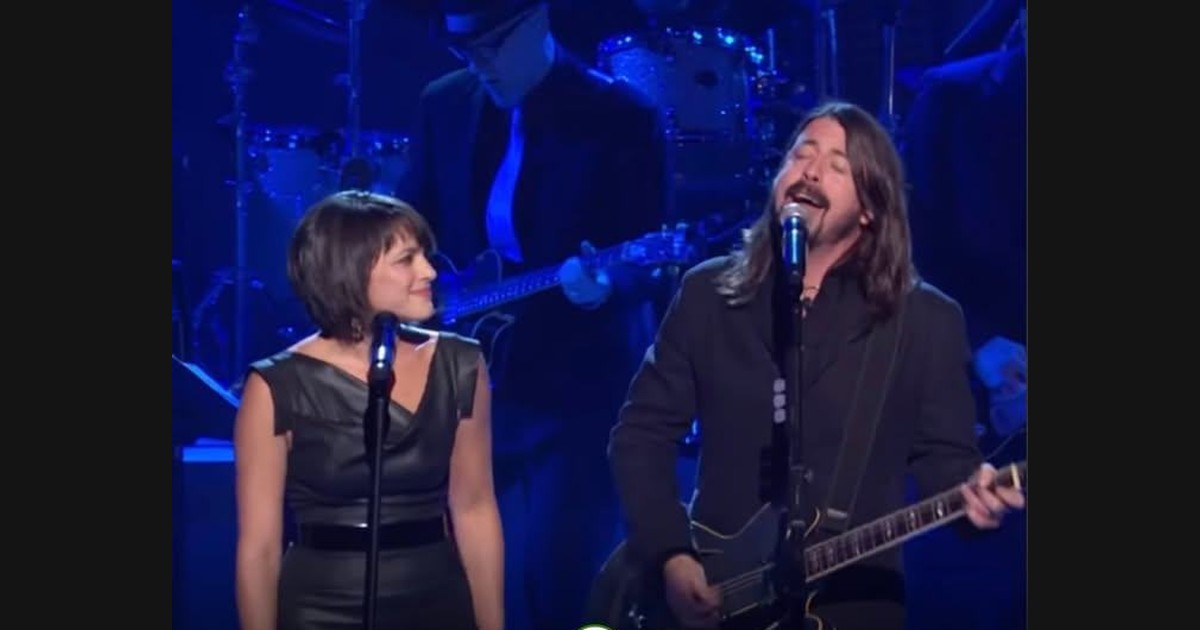
The sequence begins with Dave Grohl and Norah Jones performing “Maybe I’m Amazed” in a Paul McCartney tribute. It then moves to Jones’s “Don’t Know Why” and the Beatles’ “Here Comes the Sun.” Those connections make sense as a playlist, but they do not make the three compositions part of one songwriter’s catalog.
Keeping that distinction clear provides a useful way into the tribute. A performer, an honored artist, and a songwriter can be different people, even when a song is closely associated with one famous recording.
Watch on YouTube ↗
McCartney is the connection in the first selection
The Kennedy Center’s official upload identifies the Grohl–Jones performance with the 2010 honors. “Maybe I’m Amazed” belongs to McCartney’s 1970 solo album McCartney, rather than to a Beatles album. That supplies the composition’s direct connection with the honoree.
Grohl and Jones contribute a later interpretation in a tribute setting. Their participation does not change the authorship of the song, nor does sharing this stage establish a permanent duo. A concert can create a temporary partnership around a particular repertoire choice.
That is worth recognizing because tribute performances often introduce listeners to combinations they do not encounter in either artist’s regular releases. The immediate subject is the shared performance, while the reason for selecting the song points toward the person being honored.
Jones’s signature recording has another writer
Watch on YouTube ↗
“Don’t Know Why” is strongly associated with Jones’s 2002 debut, Come Away with Me. Her label, Blue Note, identifies Jesse Harris as its writer. The distinction between signature recording and composition credit is therefore particularly clear.
Jones’s interpretation and the song’s authorship are complementary contributions. One explains the recording through which many listeners know the music; the other identifies the person credited with writing it. There is no need to erase either role to make the other visible.
For a practical note, write two short fields: “recording artist” and “writer.” A song can have a familiar answer in the first field and a less familiar answer in the second. The exercise helps prevent a playlist from silently converting every artist association into an authorship claim.
A Beatles credit is not automatically a McCartney credit
Watch on YouTube ↗
The Beatles’ official page credits George Harrison with “Here Comes the Sun.” Its presence after the McCartney tribute broadens the band-related repertoire connection, but it does not make the song another McCartney composition.
| Selection | Connection to preserve |
|---|---|
| Maybe I’m Amazed | McCartney composition interpreted in a tribute |
| Don’t Know Why | Jones recording of a Jesse Harris song |
| Here Comes the Sun | Beatles recording of a Harrison song |
A playlist can connect without conflating
The three videos are useful precisely because the relationships change. The first connects guests with an honoree’s music; the second follows one guest into her recorded repertoire; the third returns to the Beatles through a different writer.
Once those connections are named, musical comparisons become easier to frame. You can follow an interpreter, a composition, or a group’s catalog deliberately. What you should not do is treat a shared playlist as evidence that all the performers wrote together or that every Beatles-related selection belongs to one author.


