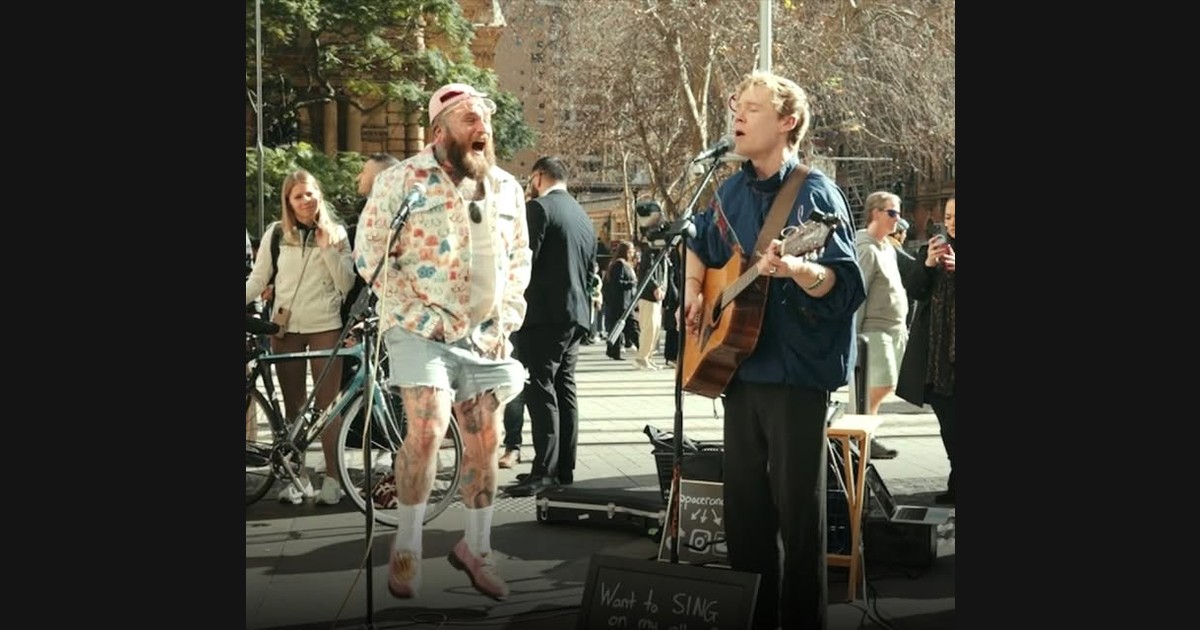
A street setting can make a performance look like an accidental encounter, but location alone does not establish how it came together. Pace Randolph describes organizing a Sydney pop-up show with Teddy Swims. That provides a clearer frame for their “Tennessee Whiskey” selection than an invented story about an unknown passerby discovering a singer.
Randolph also identifies “Lose Control” and “The Door” in his fuller account of the show. The street appearance therefore belongs to a small program, not just one disconnected musical moment.
Watch on YouTube ↗
Informal surroundings do not erase musical roles
A performance outside a conventional venue still needs somebody to carry the lead, somebody to provide support, and a shared way through the piece. The tasks remain even when the visual setting is casual.
Begin with the relationship between the singers rather than assumptions about the people standing nearby. Identify who carries a passage and what another participant contributes. A shared entrance, an answer, or a change of lead can organize a collaboration without a large stage production.
Randolph’s description gives him an organizing role as well as a performing presence. Recognizing that work is more accurate than treating him as scenery around the better-known artist. A guest appearance and the person hosting it can both be central to the event.
The song brings another credit chain
“Tennessee Whiskey” is not a Swims composition simply because it appears in his repertoire. The Country Music Hall of Fame and Museum credits Dean Dillon and Linda Hargrove as its co-writers and notes well-known recordings by George Jones and Chris Stapleton.
That background helps separate the composition’s history from this particular collaboration. Swims and Randolph undertake material with an existing life; their contribution is the interpretation and the public occasion through which it reaches listeners here.
Compare with Swims’s basement performance
Watch on YouTube ↗
“Live From Our Basement” provides another Swims presentation of the same song. Keep that format label attached to the recording rather than using it as proof of an unedited single take or a complete production method.
Choose a matching passage and compare one relationship: the lead voice against its accompaniment. Does the setting change what you notice first? Then listen again without looking at the picture. The visual informality of a street or basement can influence an impression before the musical details are considered.
For example, a close view of a singer may make the vocal seem like the only important activity. Listening for the supporting pulse can reveal another part of the performance’s organization. The purpose is to test attention, not to diagnose a recording from its appearance.
Another song from the pop-up
Watch on YouTube ↗
Randolph’s “Lose Control” upload changes the composition while retaining the publicly identified collaboration. It is useful for considering how the two performers organize another selection, rather than as another version of “Tennessee Whiskey.”
The sequence provides two distinct comparisons: the same song in different Swims settings, and the same pop-up partnership undertaking another song. Keep those questions separate and the clips offer more than a surprise narrative. They show a specific host, guest, repertoire choice, and performance occasion that can be discussed without guessing what every person knew in advance.


