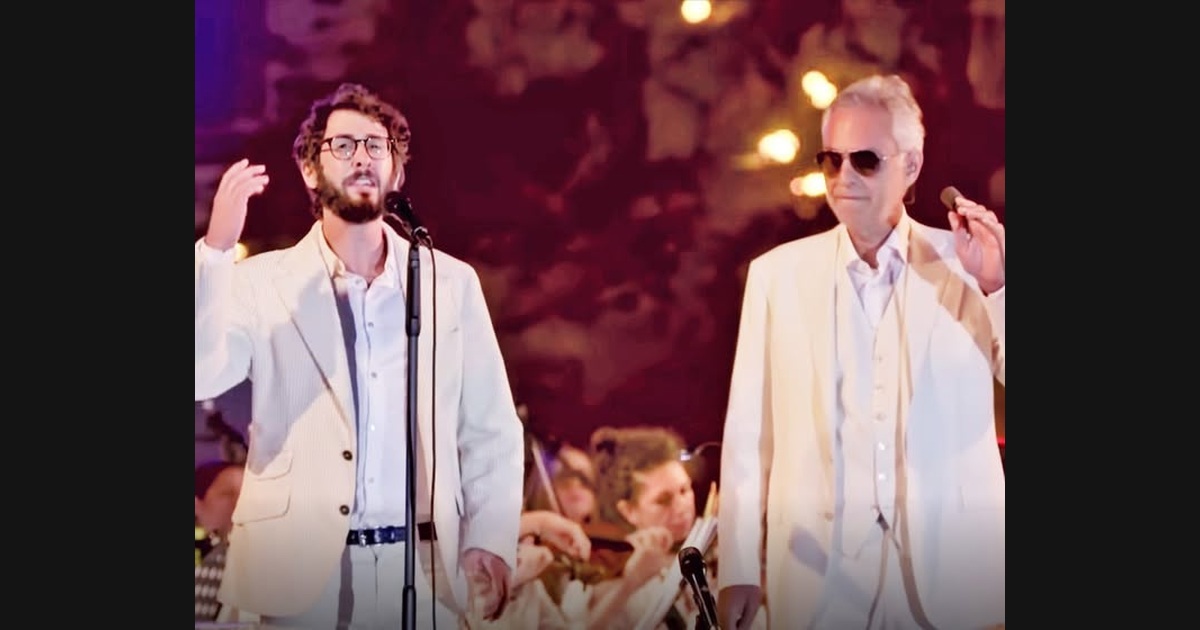
Josh Groban and Andrea Bocelli’s “We Will Meet Once Again” is not only a meeting captured in one live video. The duet also has a place in Groban’s album catalog. His official biography identifies Bocelli among the collaborators on Bridges, released in 2018, and the song appears again in the 2025 deluxe edition of his career collection Gems.
Those catalog connections provide a more useful frame than an account of two singers encountering one another for the first time. A live selection, an album, and a later anthology can present the same work for different listening purposes.
Watch on YouTube ↗
The duet as a complete musical unit
Before placing the performance inside a larger history, hear it as one piece. Follow how a statement moves from its introduction toward a returning idea. With two featured singers, the listener can attend both to the continuity of the composition and to the changing responsibility for carrying it.
A handoff does not have to create a break. The next voice may continue the same thought through a different sound, or a shared passage may make a returning idea feel like a meeting point. The useful observation names that relationship, rather than treating the duet as two independent solo performances placed side by side.
Nor does collaboration require the voices to become indistinguishable. Recognizable differences can give a shared work its shape. The arrangement’s task is to make those differences belong within a coherent course.
An album and an anthology ask different things
An album places a song among a particular set of neighboring works. A career collection selects from a much wider period and can invite attention to connections that were less visible at the time of an individual release.
Groban’s 2025 Gems announcement groups “We Will Meet Once Again” with other duet selections, including Sarah McLachlan on “Run” and Jennifer Nettles on “99 Years.” That curatorial frame makes collaboration one way into his catalog, rather than an exception outside it.
A later inclusion does not change the earlier work’s date. It changes the listener’s route to it. Someone encountering a duet through an anthology may move backward to its album context, while someone beginning with a live video may first follow the named performers.
A larger vocal collaboration
The related “The Prayer” selection from Global Citizen changes the work and expands the collaboration. Bocelli appears alongside Céline Dion, Lady Gaga, and John Legend, with Lang Lang at the piano.
Watch on YouTube ↗
Compare how featured responsibility remains clear when more contributors are involved. An additional name can mean another singer or a different musical function, so the credit list should be read with attention to roles.
Another piece in another live setting
Bocelli’s “Who Wants to Live Forever” with Brian May at Teatro del Silenzio in 2024 provides the final selection. It extends the collaboration theme through another composition and another named partner.
Watch on YouTube ↗
The three videos need not be forced into one narrative of personal friendship. They document different public musical relationships. “We Will Meet Once Again” retains its particular duet identity while its album and anthology history gives it another place to be heard: inside a continuing catalog in which collaboration is a substantial part of the repertoire.