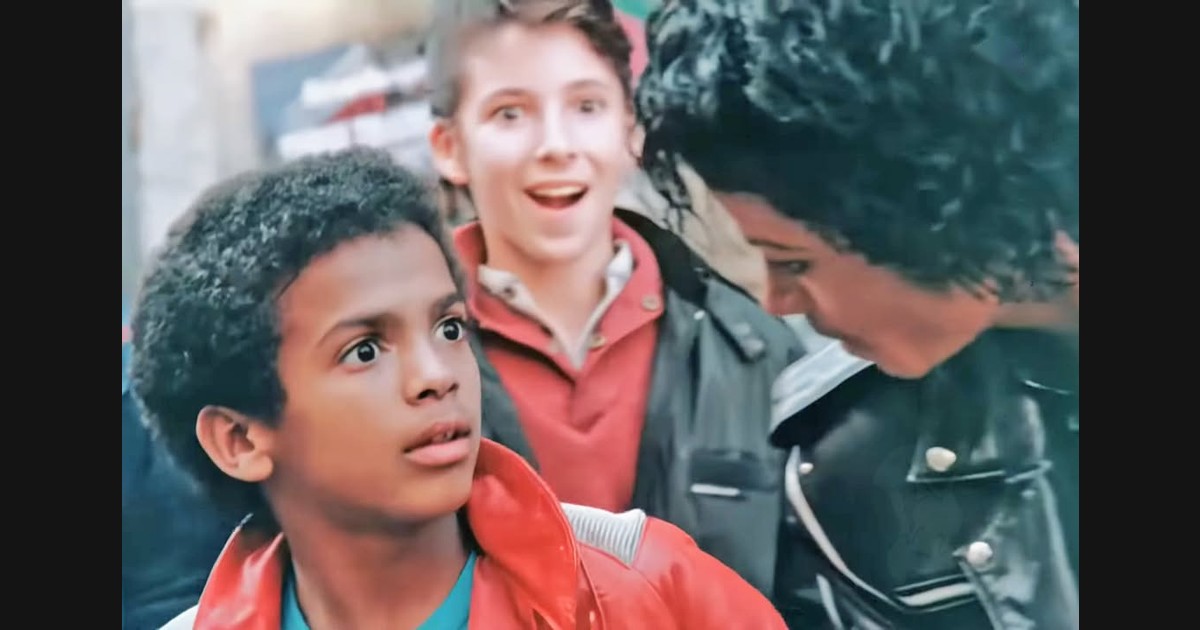
The youngster who meets Michael Jackson in Pepsi’s 1984 street commercial was not simply a fan who happened to be in the right place. He was Alfonso Ribeiro, then appearing in Broadway’s The Tap Dance Kid. Knowing that background changes the scene from an accidental discovery into a collaboration between working performers.
Contemporary reporting from the advertisement’s premiere identified Ribeiro and his stage role. It also described the Jacksons’ campaign recordings as adaptations of “Billie Jean.” Those details provide a firm historical frame for a commercial that can otherwise circulate as a short, context-free moment of celebrity recognition.
Watch on YouTube ↗
A performer plays the admirer
Ribeiro’s character expresses admiration through dance. The distinction between performer and character is important: he can convincingly portray a young person borrowing a star’s style precisely because performing is already part of his work. The scene’s apparent ease should not be confused with a lack of preparation.
A child in an advertisement may carry a story’s point of view just as an adult actor does. Here the younger character makes the established star’s cultural presence visible. Jackson’s style has reached someone who can repeat and respond to it, turning influence into something the audience can see.
Imitation can be a skilled dramatic task
Copying a recognizable gesture is not the same as copying an entire performer. A short scene needs enough detail to make the reference legible, but it also needs the younger character to remain readable as a person within the story. Recognition and characterization have to work together.
For a focused viewing, attend to who initiates a movement and who responds. The scene creates a relationship through that exchange. You do not need to assign a precise dance label to every action or assume that the encounter happened spontaneously for its choreography to communicate admiration.
The Jacksons’ wider presence also prevents the scene from being only a private meeting between two individuals. The commercial’s generational premise operates within groups of performers. A younger audience is represented as participating in an established musical world, rather than observing it from a distance.
The artist’s own video uses movement differently
Jackson’s official “Billie Jean” video gives a useful comparison. There the performer belongs to the track’s own dramatic presentation, instead of appearing as the admired figure in another character’s short commercial story.
Watch on YouTube ↗
Watch how the same recognizable artist can occupy different narrative positions. In one work, movement establishes a central musical identity. In the other, that identity is already understood and becomes something another performer can reference. The difference helps explain why a commercial can communicate so quickly.
Keep the second upload in perspective
The final video is another copy of the same 1984 campaign material. It is not evidence of a later reunion or another unscripted meeting.
Watch on YouTube ↗
Ribeiro’s stage background gives the familiar clip an additional center of interest. The scene depends on the young performer’s contribution, not only on Jackson’s arrival. Seeing him as a working participant makes the exchange more concrete: two performers make a story about musical influence, with the younger one carrying the audience into it.