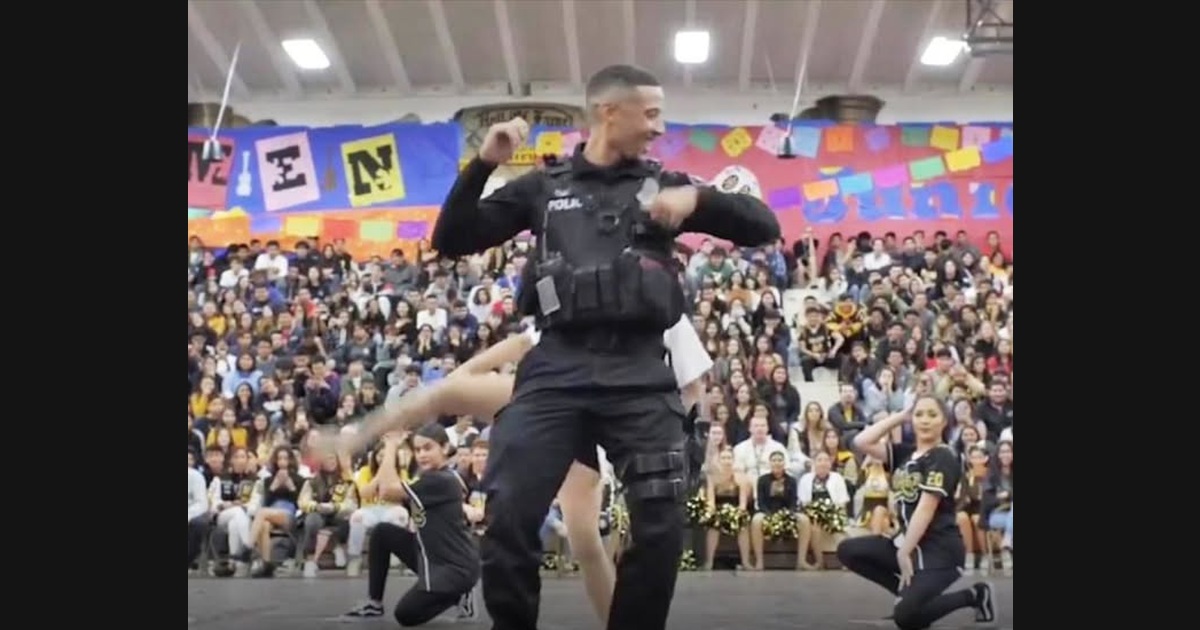
A farewell dance works differently from a farewell speech. It gives the departing person something to do with other performers, making participation part of the goodbye. The Breaking Barriers United upload presents school resource officer Ryan Tillman’s appearance in exactly that public farewell format.
Tillman’s own professional biography identifies him as the founder of Breaking Barriers United and a Southern California police officer. That connects the upload with the person involved rather than leaving it as an anonymous clip about an unidentified officer.
Watch on YouTube ↗
The role change supplies the premise
The basic contrast is easy to understand: someone associated with an everyday school role enters a musical performance. The interest comes partly from seeing how that person participates within another set of expectations, including shared timing and movement.
This does not require a claim that nobody knew what was about to happen. A performance can be entertaining even when the participants have prepared it. Surprise for a remote viewer and surprise for everyone in the room are different things.
When describing the routine, begin with a visible action. An entrance, a change in formation, or a movement repeated with another participant tells the reader what occurs. A claim about years of relationships or what every student felt would need evidence beyond the dance itself.
Look for the structure of a short act
A compact performance needs an opening, a way to develop its idea, and an ending the audience can recognize. Follow those three functions rather than collecting isolated “best moves.” The opening establishes who is taking part; the middle gives the performers shared material; the finish closes the appearance.
For example, a repeated gesture can become a point of recognition if it returns after another movement. A formation change can redirect attention without introducing a new song. These are possibilities to check against the clip, not a claim that every short school routine uses the same design.
The occasion also matters. A farewell supplies a reason for the appearance before the choreography begins. The dance can therefore stay relatively compact: it does not need to explain the entire departure through movement.
Compare a skit organized around coordinated hands
Watch on YouTube ↗
The next upload presents a “Hand Clap Skit.” Use it to examine how limited movement material can become a complete act. When a performance concentrates on hands, the order of gestures and the relationship between participants carry much of the structure.
Compare that with a routine using a larger performance area. Ask what the audience needs to see to follow the idea: small coordinated actions, changes in position, or an entrance that establishes a new participant. Different acts need different kinds of visual clarity.
A talent skit adds another performance frame
Watch on YouTube ↗
The final upload is labeled “Funny Talent Skit.” That label announces a comic performance, whereas the main clip announces a farewell. The distinction helps explain why similar devices, such as repetition or a conspicuous role change, can serve different occasions.
A useful comparison stays with the acts. Identify one device in each recording, explain its function, and keep the people involved attached to their own event. There is no need to decide which community cared more about its performers.
Tillman’s appearance is most clearly understood as a particular person joining a particular school farewell. Its value as a performance lies in the public act of participation and the routine’s readable structure, rather than an unsupported claim that one dance proves a broader institutional outcome.


