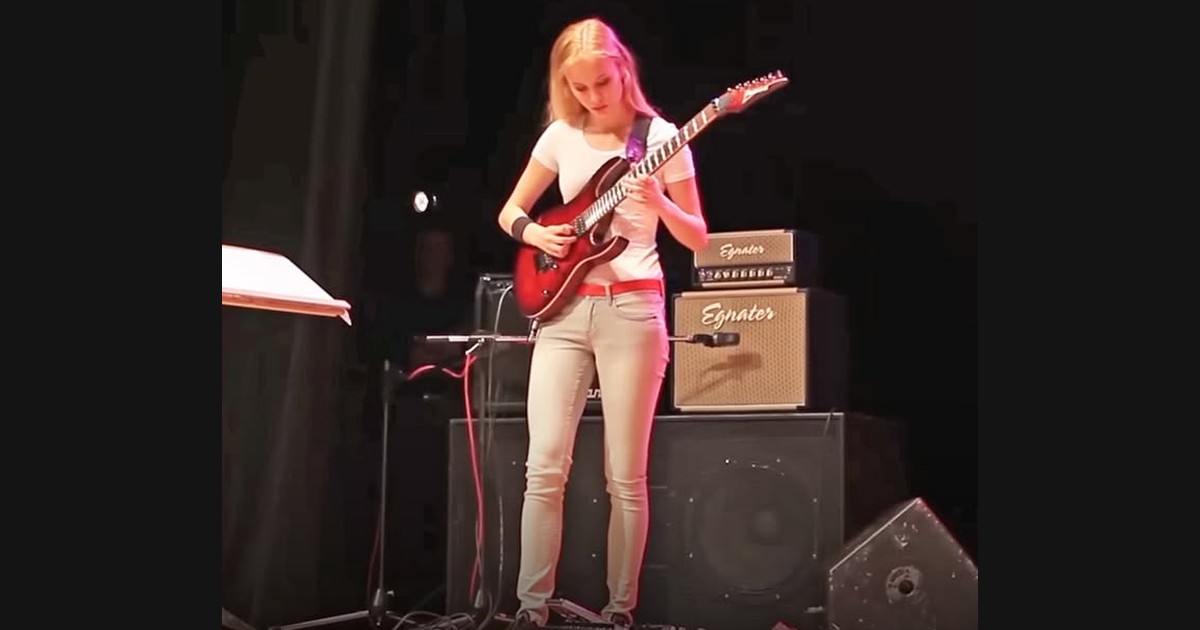
Three guitar uploads can produce a confused comparison if the source piece, performer, and recording context are changed all at once. Laura Lāce’s “Canon Rock,” “Summer Presto,” and a live “Summer” selection offer a way to organize the listening more carefully.
The first title identifies a JerryC cover; it does not identify a live concert. The third explicitly labels itself a live version. Ibanez’s artist profile connects Lāce with the Laura6100 name and with the “Canon Rock” upload on her teacher’s Vi Gi channel. Those details establish continuity of performer without inventing one shared recording occasion.
Watch on YouTube ↗
Pass one: give one performance its own shape
Before comparing, hear “Canon Rock” as a complete arranged piece. Identify a beginning, one substantial change, and the route toward the ending. Use descriptions you can recognize again, such as a recurring idea returning after a contrasting passage.
This first pass creates a reference larger than a few conspicuous seconds. It prevents a later comparison from reducing the whole performance to whichever passage happens to be fastest or easiest to recognize.
Also distinguish what you can hear from what you can see. A close view may help locate an action on the instrument, but it does not automatically establish a complete account of how the recorded sound was produced.
Pass two: change the source material
The Laura6100 “Summer Presto” cover changes the work. Keep the comparison at the level of how musical ideas are connected, rather than expect the new source to use the same design as “Canon Rock.”
Watch on YouTube ↗
Choose one subject that is available in both: the preparation of a return, the contrast between sustained and active material, or the connection across a section boundary. Follow that subject through a complete passage in each recording.
For example, if a return felt particularly clear in “Canon Rock,” identify what prepared it. Then look for a comparable sense of arrival in “Summer Presto,” allowing the means to differ. You are comparing a musical function, not claiming that the passages are the same.
Pass three: change the presentation
The final upload supplies a live “Summer” version. Its title gives another presentation label, while leaving the exact relationship between every passage of the two “Summer” uploads to be examined rather than assumed.
Watch on YouTube ↗
Keep the distinction between an event and its recording. A live label identifies a performance context; it does not prove that a published video contains no editing, mixing, or later processing. Those production questions should not be resolved from a title alone.
For the listening session, concentrate instead on how the available view directs attention. Does it help you follow a phrase through its whole course, or make a particular instrumental action prominent? The answer concerns the presentation you actually have.
Write a comparison that names its subject
A useful final note can be brief but precise: “I followed the return of an idea in the first two pieces, then considered how the live presentation changed what I could see.” That says more than an unsupported verdict about which recording is most authentic.
Lāce’s three selections then form a purposeful session. “Canon Rock” establishes one arranged work, the “Summer” cover changes the material, and the live upload changes the presentation. Keeping those steps distinct makes the comparison clearer and gives each performance room to communicate its own musical course.


