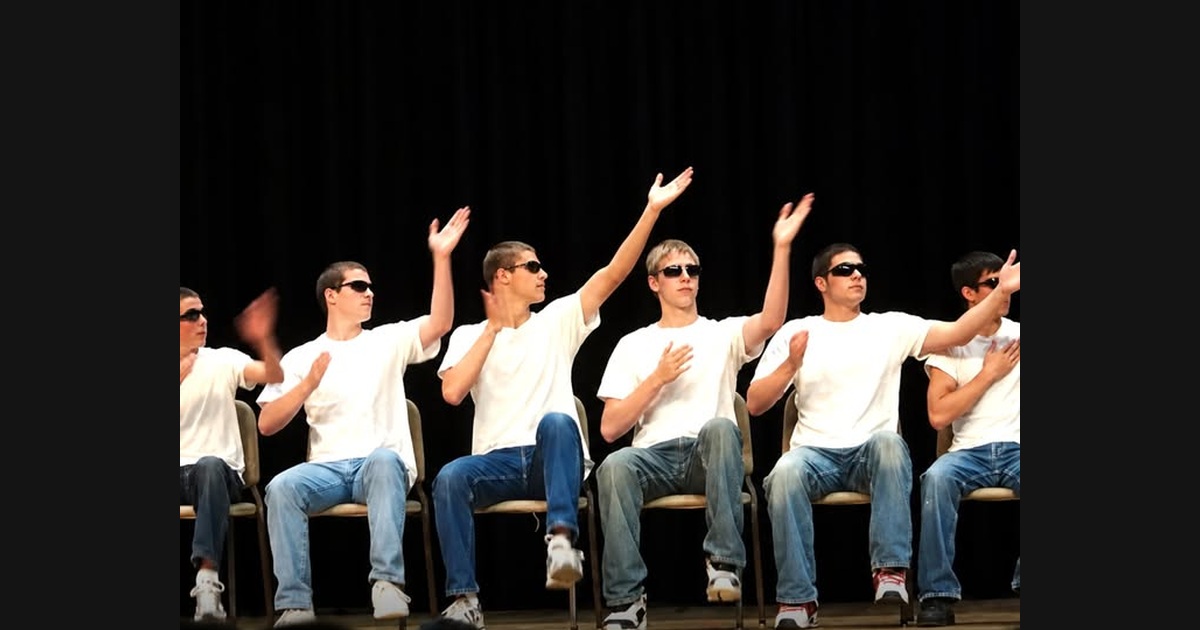
The “Hand Clap Skit” starts with an economical stage idea: performers stay seated, while their hands provide the movement. A row that might seem visually static becomes the framework for a changing rhythmic pattern. The audience follows the action because the physical arrangement remains easy to understand.
The original uploader identifies the occasion as a youth-conference talent show. The description does not establish a named professional company or a formal championship, so the routine is best approached on its own terms. Its interest lies in the organization of a few available materials: bodies, chairs, gestures and timing.
Watch on YouTube ↗
A stable frame makes changes legible
When performers remain in fixed positions, the viewer can recognize who is next to whom without repeatedly rebuilding a mental map of the stage. A gesture can move through the row even though the people do not travel. In that sense, sequence replaces distance as the source of visible motion.
Two useful terms are unison and staggered entry. Unison means that performers act together; a staggered entry starts the same or a related action at different moments. Neither is inherently more difficult to understand. The contrast between them helps a routine establish an expectation and then vary it.
Sound and movement share a boundary
A clap supplies both a visible meeting of hands and an audible event. A silent gesture can prepare that event or contrast with it. This gives body percussion an unusually direct relationship between what viewers see and what they hear.
For a focused viewing, choose one performer and follow the beginning and ending of an action. Then widen your attention to neighboring performers. The important question is whether the action is simultaneous, passed along or answered by something different. There is no need to reconstruct every hand position to understand the larger pattern.
A simple practice illustration makes the distinction clear: imagine three people clapping once together, then clapping once each in left-to-right order. The number of claps can remain the same while the experience changes from a single combined event to a short sequence. This is an explanation of pattern, not a transcription of the recorded routine.
Another ensemble with visible rhythmic work
The Barcelona Guitar Trio and Dance’s “Billie Jean” performance places coordination in a different setting. The presenting organization’s title identifies a tribute to Paco de Lucía. Guitars and dance create several possible centers of attention instead of one seated line.
Watch on YouTube ↗
Compare how each performance directs your eye toward an entrance. A fixed row can let position establish the next event; a mixed performance may use a change of activity or a more prominent movement. The common issue is making relationships readable, not making every performer do the same thing.
From a row to a partnership
The third recording presents swing dancing in a competition setting. Its spatial relationships differ again: movement between partners becomes part of the visible structure.
Watch on YouTube ↗
Across the three videos, coordination does not mean the absence of individuality. It means that one person’s action has a clear relationship to another’s. The hand-clap routine makes that principle especially approachable. With very little stage scenery and no need for travel across the floor, a group can still create direction, surprise and a recognizable pattern for an audience to follow.


