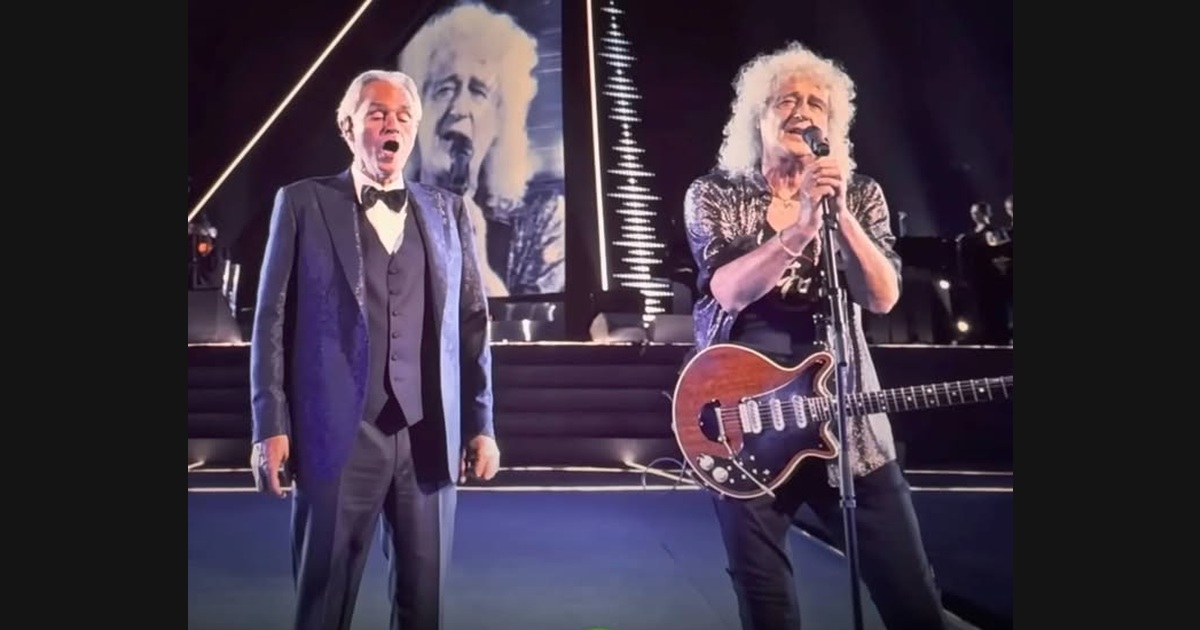
Andrea Bocelli’s collaboration with Brian May on “Who Wants to Live Forever” connects two different kinds of familiarity. Bocelli brings the identity of a guest interpreter to the Queen song, while May brings a direct connection to its composition. That makes this more specific than an encounter between two famous names.
Queen’s official site credits May with writing the song for the 1986 film Highlander. It also identifies the Bocelli collaboration as a performance at Teatro del Silenzio in Tuscany in 2024. The song’s history and the concert’s date therefore belong to separate stages of its life.
Watch on YouTube ↗
The writer and the interpreter have different jobs
It is tempting to call a cover a meeting between an “original” artist and a replacement. That description is too narrow here. May’s presence supplies continuity with the composition, while Bocelli’s role gives the material another lead interpretation. Neither fact requires the new performance to reproduce Queen’s recording.
Think of the song as a structure that can accommodate different performing forces. The melody and its returning sections establish identity. Decisions about vocal delivery, instrumental support, pace, and scale determine how that identity is presented on a particular occasion.
To make the distinction concrete, compare the importance of an individual phrase with the transition into the following section. A singer may direct attention toward the phrase itself; an accompanying part may prepare the transition. Those functions can complement each other without competing to be the most prominent sound.
Keep the release timeline straight
Queen published its notice of this performance in September 2025, describing it as a 2024 appearance and connecting the track with Andrea Bocelli 30: The Celebration. A later publication is not evidence of a later concert.
| Reference | What it identifies |
|---|---|
| 1986 | The song’s Highlander-era origin |
| 2024 | The Teatro del Silenzio performance |
| 2025 release notice | A later presentation of that performance |
This matters when discussing collaborations online. A newly encountered clip can preserve an earlier event. The useful question is which performance the release documents, not simply when a video appeared in a feed.
Compare a different Bocelli collaboration
Watch on YouTube ↗
“We Will Meet Once Again,” presented by Josh Groban with Bocelli, provides a comparison centered on a shared performer rather than a shared composition. Listen for how two lead singers divide responsibility: separate statements, joined passages, or a change in emphasis when another voice enters.
Do not carry May’s songwriting credit over to this selection. Its value in the sequence is the chance to compare collaboration formats, not evidence that all three videos share an author or a single musical project.
Return to Queen without flattening its catalog
Watch on YouTube ↗
“Bohemian Rhapsody” restores Queen’s own recorded identity to the comparison, but it is another song. Its changing sections make a useful reminder that a band’s catalog contains different compositional designs; one Queen title cannot serve as a musical description of every other.
The clearest account of the Bocelli–May performance keeps three statements distinct: May wrote the song, Bocelli participates in a later interpretation, and this recording documents a particular concert appearance. From there, musical comparisons can become more precise than a general claim that classical and rock have simply “merged.”


