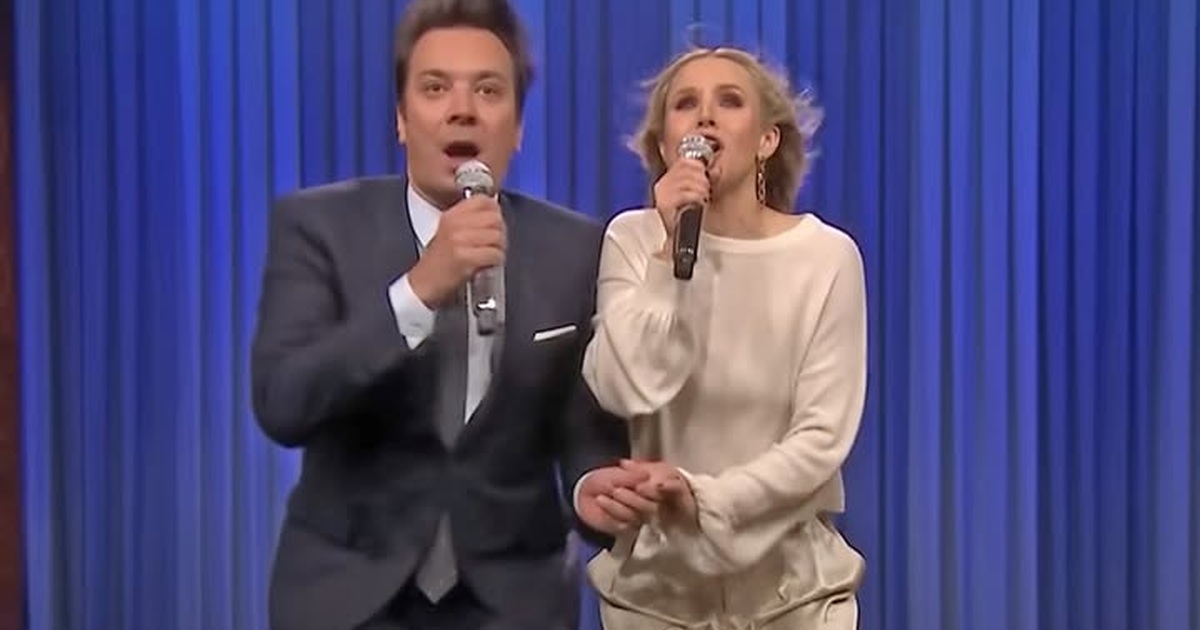
A few notes can recall far more music than a performer actually sings. Kristen Bell and Jimmy Fallon’s “History of Disney Songs” makes that gap between a fragment and a remembered whole part of the entertainment. The medley offers a succession of selections, while a listener’s familiarity supplies associations that extend beyond each excerpt.
Its title is best approached as the name of a television segment, rather than a promise of a complete historical survey. A medley has to select, compress, and move onward. Those limits are part of its musical design.
Watch on YouTube ↗
The listener completes the fragment
Recognition can occur before a passage has finished explaining itself. Someone who knows a song may anticipate the next phrase, remember its scene, or silently continue the melody after the medley moves away. Someone hearing the same excerpt for the first time has a different task: making sense of the material actually presented.
Try separating those two experiences. During a familiar selection, notice the first musical detail that identifies it for you. Then consider what the excerpt would communicate without the rest of your memory. A recognizable phrase can be effective as a reference while remaining only a small part of a song’s original course.
The distinction also explains why recognition is not the same as interpretation. Identifying a title answers which song has arrived. Hearing the relationship between its opening and ending requires time that a rapid medley may deliberately withhold.
Continuity can live between the songs
Since an excerpt cannot carry every stage of its original composition, the medley needs another source of continuity. Its overall route comes from the connection between selections and the continuing presence of the performers. The audience follows the sequence as well as the individual tunes.
A useful second listen concentrates on departures. Notice when you begin to expect more of one song and how the next selection redirects that expectation. The interruption can become a form of punctuation, rather than a flaw in a performance that was never intended to reproduce every song in full.
Restore time to one selection
Disney’s “Love Is an Open Door,” performed by Bell and Santino Fontana, changes the scale of attention. Instead of asking a song fragment to announce its identity quickly, the related selection allows the relationship between its phrases to become the subject.
Watch on YouTube ↗
Follow how a thought is introduced and then developed through the exchange between singers. Even if a passage is already familiar, resist skipping mentally to the most recognizable point. The route can explain why that destination is satisfying.
A sing-along changes participation again
Idina Menzel’s “Let It Go” in Disney’s sing-along presentation offers a third relationship between song and audience. A medley invites recognition; a duet invites attention to exchange; a sing-along explicitly makes room for participation.
Watch on YouTube ↗
The same listener can enjoy all three without asking each format to do the same job. Singing along may bring attention to the sequence of words, while a fragment may primarily trigger memory of a larger work.
Bell and Fallon’s medley is therefore most rewarding as an arrangement of remembered musical landmarks. Returning to longer selections afterward reveals what its quick references depend upon: complete songs with room to establish, develop, and resolve their own ideas.


